"So what does all of this actually cost?" It's usually the first question I'm asked — often before "what can it do?" — and the honest answer is: somewhere between free and terrifying, depending on how you buy it. The good news is that AI pricing is far simpler than the providers make it look. There are only two ways to pay, and once you understand them, the whole thing clicks into place.
One promise before we start. AI prices move often, so every number in this article was checked against the providers' own pricing pages on 23 October 2026, the price table below links to each source, and we re-check them monthly. The mechanics I'll explain — how the pricing works — change far more slowly than the numbers themselves.
The two ways to pay
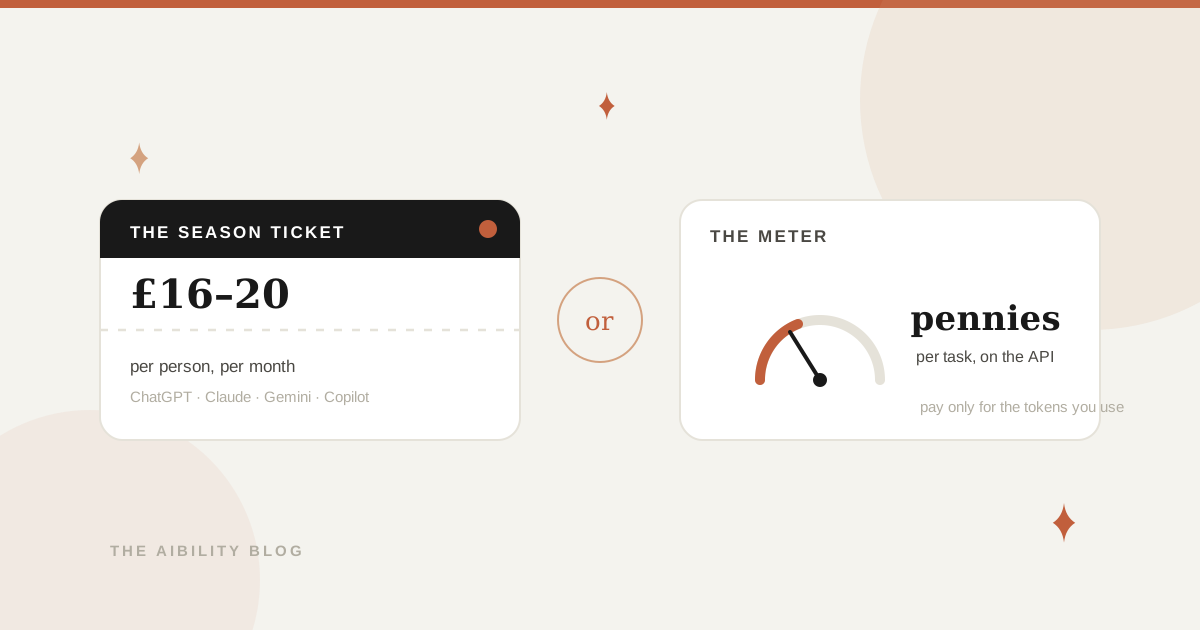
Think of it like getting around a city. You can buy a season ticket — a flat monthly fare, travel as much as you reasonably like. Or you can ride the meter — pay nothing up front, and a small charge ticks up with every mile you actually travel.
AI is exactly the same. The chat apps — ChatGPT, Claude, Gemini — are the season ticket: a fixed price per person per month. The API (the route developers use to build AI into systems and automations) is the meter: you pay only for what you use, measured in a unit called the token. Most businesses end up using both — the season ticket for people, the meter for automation.
The season ticket
Here the market has done something genuinely helpful: it has converged. ChatGPT Plus, Claude Pro, Google AI Pro and Microsoft 365 Premium (the version with Copilot built in) all cost about £19 or $20 per person per month — Google and Microsoft publish £18.99 in the UK; OpenAI and Anthropic publish $20 and show your local price at checkout. Each unlocks its provider's top models with generous everyday limits (Claude's very top tier, Fable, runs on pay-as-you-go credits on Pro). There are heavier-duty tiers — from £79.99 a month for Google AI Ultra, and from $100 for ChatGPT Pro and Claude Max — for people who genuinely hammer the tools all day. Business versions, with admin controls and data protections, cost about the same per seat or a little more: ChatGPT Business and Claude Team are $20 a user per month billed annually, or $25 billed monthly. But for anyone starting out, one personal subscription is the whole budget. If it doesn't earn its keep, cancel it next month.
The meter — and what on earth is a token?
A token is simply a chunk of text — somewhere between half and three quarters of a word, depending on the model. A typical page of A4, about 500 words, comes to somewhere between 650 and 900 of them. The meter charges per million tokens, in two directions: what you send in (your documents and questions) and what the model sends out (its answer). Output costs around five times more than input — reading is cheap, writing is the hard work.
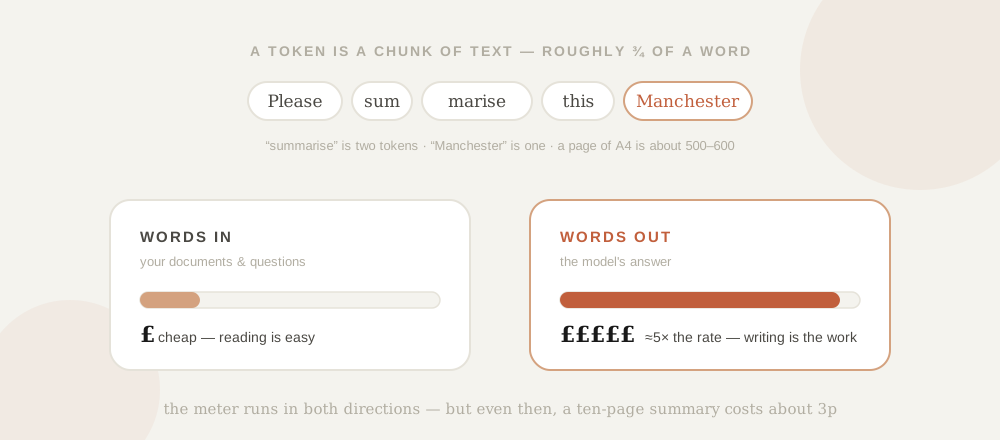
If those numbers sound abstract, here's what they mean in the real world: asking the mid-tier Claude to summarise a ten-page report costs about two pence. Not per page — for the whole job. The meter sounds scary precisely because nobody tells you how tiny the fares are.
The price list
In Which Model to Choose? I described every provider's range as three tiers — the flagship, the all-rounder, and the small-and-speedy. The price list below follows exactly that shape, and it's where the tiers really earn their keep: the runabouts cost anywhere from five to a hundred times less than the flagships.
| Provider | Model | Tier | In ($/million tokens) | Out ($/million tokens) |
|---|---|---|---|---|
| Anthropic | Claude Fable 5.1 | Flagship | $10.00 | $50.00 |
| Anthropic | Claude Opus 5.5 | Flagship | $4.00 | $20.00 |
| Anthropic | Claude Sonnet 5.5 | All-rounder | $2.00 | $10.00 |
| Anthropic | Claude Haiku 5.5* | Small & speedy | $0.10 | $0.50 |
| OpenAI | GPT-6 Astra‡ | Flagship | $10.00 | $50.00 |
| OpenAI | GPT-6.1 Sol‡ | All-rounder | $2.00 | $10.00 |
| OpenAI | GPT-6 Luna‡ | Small & speedy | $0.10 | $0.50 |
| Gemini 4 Argon† | Flagship | $2.00 | $10.00 | |
| Gemini 3.8 Flash† | All-rounder | $0.75 | $3.75 | |
| Gemini 3.5 Flash-Lite | Small & speedy | $0.30 | $2.50 |
Prices checked 23 October 2026 against Anthropic, OpenAI and Google's official pricing pages — follow those links for today's rates. *Haiku 5.5 prices are for prompts up to 100,000 tokens; above that it's $0.50 / $2.50. ‡OpenAI prices are for prompts up to 272,000 tokens. †Google has announced rises: Gemini 4 Argon goes to $4 / $20 from 1 December 2026, and Gemini 3.8 Flash to $1.50 / $7.50 from 1 January 2027.
What that means in practice
Let's price a real job. Say you want AI to read 1,000 supplier invoices a month and pull out the totals, dates and references — a couple of pages in, a neat summary out, times a thousand. On Claude Haiku, the small and speedy tier, the entire month's run costs about 33 cents — roughly 25p. Run the same job on the flagship and it's closer to £25: a hundred times the price for a task the little model handles perfectly well.
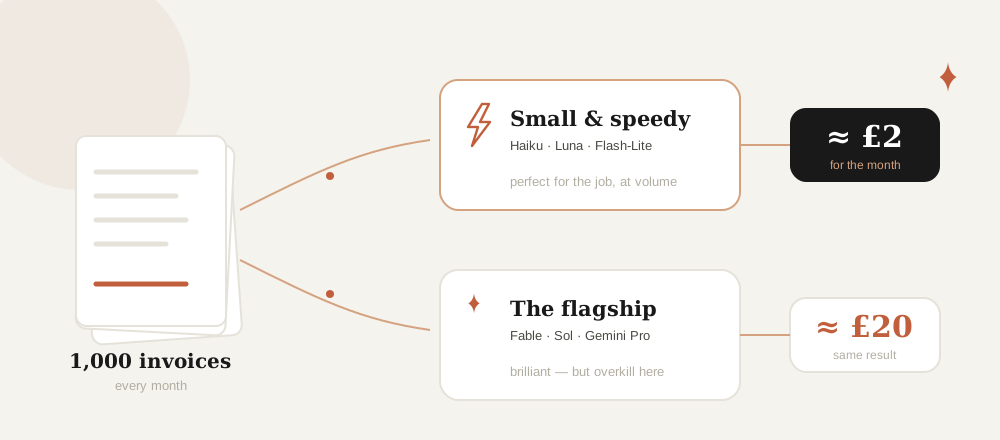
At automation scale you don't budget per month — you budget per thousand tasks. And the answer is usually pennies.
This is also why the foreman and crew pattern from the last article matters commercially, not just technically: the flagship does the expensive thinking once, then delegates the thousand-fold legwork to models charging a fifth of its rate or less — a hundredth, for the smallest. Flagship judgement, runabout prices.
The costs nobody puts on the pricing page
Two honest warnings. First, vague briefs are the real expense. A poorly-described task doesn't just produce the quad bike from What is AI? — you pay for the quad bike, then pay again for the car. Clear instructions are a cost control, not just a quality one. Second, the biggest line on the bill is usually people time: learning the tools, refining the workflows, wiring AI into your systems. The tokens are pennies; the adoption is the investment.
So what should you budget?
Exploring? One subscription of about £20 a month per curious person — that's it. Rolling it out to a team? Budget the business tier, about the same per seat or a little more, and spend the savings on a bit of training. Automating something at volume? Stop thinking per month and start thinking per task — measure one job on the meter, multiply, and you'll usually find the answer is pounds, not thousands.
How we can help you
Working out the true cost of AI for your business — which subscriptions are worth it, which jobs belong on the meter, and which models keep that meter kind — is exactly what we do at AIbility. We'll help you put real numbers against real tasks before you spend a penny more than you need to.
If you'd like to see those numbers for your own tasks, book a free call.